Early Access

Kite the Planet

This platform is in private beta. Sign in to continue.

🇧🇷South America, Brazil

CUMBUCO

Trade winds, pink lagoons, and the most reliable kite window in South America.

300+
Wind Days/Year
22 kts
Avg Wind Speed
26–29°C
Water Temp
Jul–Sep
Peak Season
Scroll

Named Kite Spots

Cumbuco Main Beach

All Levels

The heartbeat of Brazilian kiting. A 4 km stretch of north-facing beach with consistent ESE trade winds arriving side-onshore from the right. Launch at low-to-mid tide when the sandbar exposes clean water. Mornings are lighter and glassy; winds build through noon and peak in the mid-afternoon at 22–30 knots. The beach has dedicated launch/landing zones managed by the local kite schools — respect the separation from the fishing boat zone at the west end.

FreerideFreestyleBeginnersFoilTide-dependent

Hazards: Fishing boats at west end, crowded launch in peak season, afternoon gusty chop

Access: Direct from village — walk from any pousada

Lagoa do Banana (Bananal)

All Levels

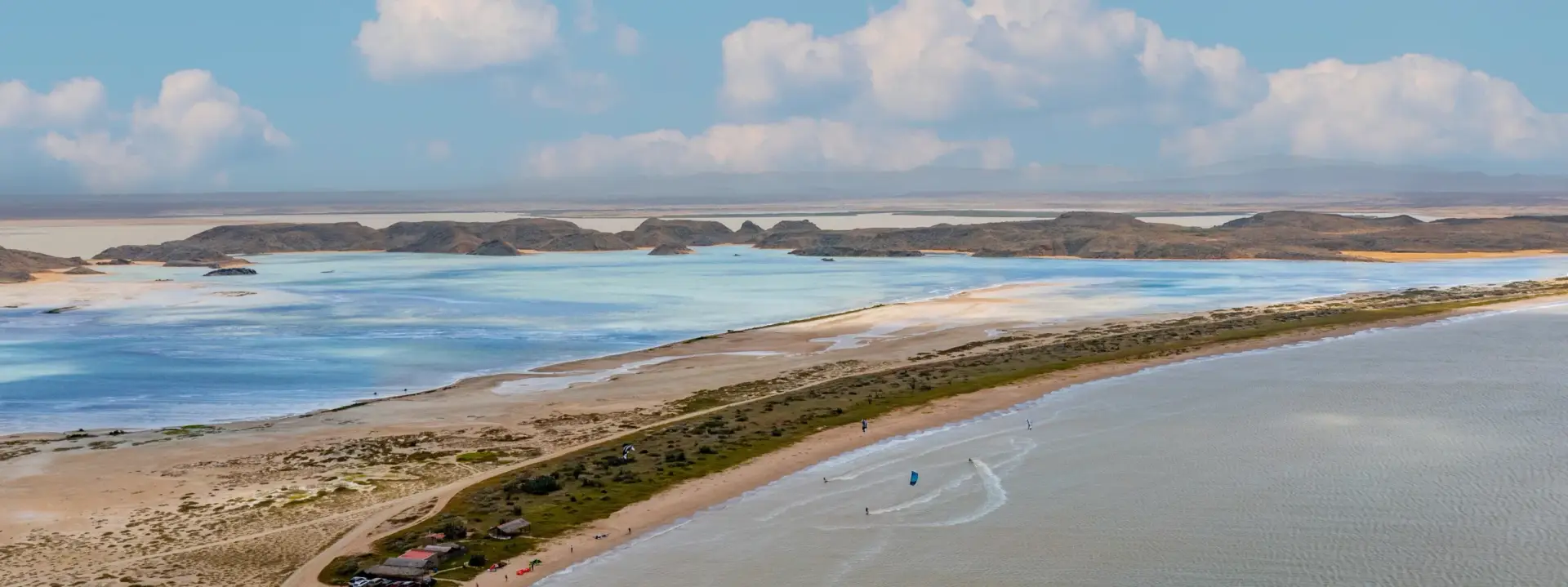
The most photographed kite spot in South America. A shallow pink-tinted lagoon tucked behind the dunes, less than 3 km from Cumbuco beach. The dunes funnel and accelerate the ESE wind into a consistent 18–24 knot stream across flat, ankle-to-knee-deep water. Colors shift from turquoise to rose at different times of day as algae and sediment interact with the light. Buggy dune tours stop here for swimming — time your session around them or go early morning. The return ride upwind is short and easy.

FreestyleFreerideFoilBeginners

Hazards: Shallow edges, dune buggy traffic (schedule around tours), occasional swimmers

Access: 15-min dune buggy ride from village (~R$80–120 shared), or 3 km walk through dunes

Lagoa Cauípe

All Levels

Brazil's largest dedicated kite lagoon, 15 km north of Cumbuco village. Cauípe stretches 4 km across with consistent wind funneled off the dune belt. Waist-deep maximum, warm water, sandy bottom with no hazards — the cleanest learning environment in South America. The kite school operations here are well-organized with instructors in the water. Strong intermediate riders use the open center for hooked-in freestyle and foiling. Crowds are spread across a massive surface area, unlike the beach.

BeginnersFreestyleFoilFreeride

Hazards: Long drive from village; very remote if something goes wrong without a school escort

Access: 25 min by car or motorbike taxi (~R$50–80 each way); some camps organize transfers

Taíba Beach

Intermediate–Advanced

A fishing village 35 km north of Cumbuco with a growing international kite community. Trade winds hit Taíba slightly stronger and more consistent than Cumbuco proper — the exposure is cleaner. Beach waves and swell breaks make this the go-to wave kiting destination on the Ceará coast. The NE swell direction combined with the ESE wind creates side-offshore conditions ideal for wave riding. Multiple kite schools have relocated here for the season.

WaveSurfFreerideTide-dependent

Hazards: Wave environment requires kite control, rock sections at north end of beach

Access: 40 min by car from Cumbuco village; some camps run day-trip transfers

Icaraí de Amontada

Advanced

The end-of-the-road spot: 130 km northwest of Cumbuco, beyond Trairi. Icaraí sits at a right-angle bend in the coast where the ESE trades arrive perfectly side-shore. Strong, consistent, and rarely crowded. A Ceará tradition among local riders is the multi-day downwinder from Cumbuco to Icaraí — covering 130 km of coastline, kiting from village to village, camping under the stars. The infrastructure is minimal; pack what you need.

DownwindWaveFreeride

Hazards: Remote location, limited rescue services, long open-ocean stretches for downwinders

Access: 2.5 hr drive from Cumbuco; downwind kite excursion organized from Cumbuco camps

Paracuru

Intermediate

A small fishing town and established kite destination 60 km west of Cumbuco. The ESE trades hit Paracuru slightly stronger and from a cleaner angle — the coastline curves to face the wind more directly. Several kite schools operate here permanently with a local Brazilian community rather than a tourist-dependent one. A natural lagoon behind the beach provides flatwater options; the point break delivers the best wave kiting on the Ceará coast. Increasingly chosen by experienced riders from Fortaleza who want uncrowded water.

WaveFreerideFreestyleFoilTide-dependent

Hazards: Rocky sections at the point break; wind can be stronger and gustier than Cumbuco; boat traffic near the fishing port entrance

Access: 60 km west of Cumbuco via CE-085 — 1 hour by car; some Cumbuco camps organize day-trip transfers

Mundaú / Flecheiras

Intermediate–Advanced

Coordinates pending: local verification required

A remote stretch of coastline 120 km northwest of Cumbuco — a series of interconnected lagoons, sand dunes, and empty beaches that serve as the classic Ceará downwinder's endpoint. The village of Mundaú sits at the mouth of a tidal lagoon where fishing boats and kites coexist. Flecheiras beach nearby has consistent side-shore trade wind and a community of fishermen who kite for sport. The landscape — palm-fringed colored sandstone cliffs, turquoise lagoon, no crowds — is extraordinary even by Ceará standards.

DownwindFreerideWaveTide-dependent

Hazards: Remote — minimal rescue infrastructure; strong tidal flow in lagoon mouth channel; fishing boat traffic; multi-day logistics require advanced planning

Access: ~2 hr drive from Cumbuco via CE-085 and local roads; classic endpoint of the multi-day Cumbuco–Mundaú coastal downwinder
Wind & Conditions

75/100Wind Reliability
Intermediate+
MonthWindWindy DaysWater TempNotes
Jan18–25 kts
~75%
28–29°CLate season; still reliable, lighter than peak
Feb12–18 kts
~45%
28–29°CLow season; summer rains reduce consistency
Mar10–16 kts
~40%
28°CLightest month; wet season peaks
Apr12–18 kts
~45%
27–28°CShoulder; rains tapering off
May16–22 kts
~60%
26–27°CSeason building; increasingly reliable
Jun20–26 kts
~75%
26°CSeason opens; consistent trades established
JulPEAK24–32 kts
~90%
26°CPeak begins: strong and consistent
AugPEAK24–32 kts
~90%
26°CPeak: most powerful, can be overpowered mid-afternoon
SepPEAK22–28 kts
~85%
26–27°CExcellent: peak strength, more manageable than Aug
Oct20–26 kts
~80%
27°CHigh season: great all-round conditions
Nov20–26 kts
~80%
27–28°CHigh season: reliable, warm water
Dec18–24 kts
~75%
28°CLate season: consistent, water heating up

Kite Size Guide

Low Season (Feb–Apr)12–15 mLighter wind; larger kites essential — consider skipping or coming for waves only
Building (May–Jun)10–12 mGood versatile range for the developing trades
Peak (Jul–Aug)7–9 m5–7 m needed on heavy 30+ knot afternoons
High Season (Sep–Nov)9–11 mBest all-round conditions; 9 m is the workhorse
Late Season (Dec–Jan)9–12 mSlightly lighter; 10–12 m covers most days

General rule: two kites covering 7–10 m handles 80% of peak season days for a rider at 75–80 kg

Water & Wetsuit

Water Temp
26–29°C
Warm year-round — equatorial Atlantic
Wetsuit Rec
Rash guard / UV suit
No wetsuit needed year-round. UPF 50+ rash guard recommended for sun protection

Equatorial sun at 3°S is intense — SPF 50+ is not optional. Burns at 11 AM are severe even on overcast days.

💨

The ESE Trade Wind Machine

Cumbuco's wind is driven by the Southeast Trade Winds — part of the global atmospheric circulation that makes Northeast Brazil one of the most reliable kite destinations on earth. The ESE direction arrives side-onshore on Cumbuco beach and side-shore to onshore across both lagoons. Wind builds from mid-morning, peaks between 1 PM and 4 PM, and drops sharply after sunset. The consistency between June and January means you rarely lose a full day — the question is whether it's a 20-knot day or a 30-knot day, not whether it will blow at all.

Camps & Accommodation

Choose Your Base

Cumbuco is compact — most camps are within walking distance of the main beach. The choice is between a social kite school atmosphere in the village, a purpose-built kite resort up the coast, or a design-led eco-resort for riders who want quality accommodation without the camp-house vibe.

Brasil Kite Camp

Kite School

One of Cumbuco's original and best-established kite camps. Brazilian and international staff, IKO-certified instruction, equipment from multiple brands. Social atmosphere with a dedicated kite house, pool, and bar. Beginner through advanced clinics, plus guided lagoon excursions to Cauípe and Taíba.

Highlight: Top-rated beginner program; organized lagoon day trips

Gear Brand
Mixed (Cabrinha, North)
Price Range
Mid-range

Kite Brasil

Kite School

Long-running IKO school with one of the most complete gear fleets on the Ceará coast. Lessons conducted partly on the beach and partly at Lagoa Cauípe. Weekly kite packages include accommodation in their affiliated pousada. Staff speaks Portuguese, English, and Spanish.

Highlight: Full-week kite packages; multilingual instruction

Gear Brand
Duotone / North
Price Range
Mid-range

Cumbuco Kite House

Kite School

Boutique kite school with a deliberate focus on small group sizes (max 2 students per instructor). Lagoon-focused teaching program. Comfortable rooms in the adjacent pousada. Popular with solo travelers and couples who want personalized instruction without a factory camp feel.

Highlight: Small group instruction; intimate camp atmosphere

Gear Brand
North
Price Range
Mid-range

Rancho do Peixe (Taíba)

Kite Resort

Iconic kite resort in Taíba, 35 km north of Cumbuco. The wave kiting destination of the Ceará coast. Famous for its wave IKO instructor program, annual wave competitions, and the strongest, most consistent wind exposure on the Ceará coast. Their lagoon (Lagoa Azul) is directly in front of the property.

Highlight: Best wave kiting setup on the Ceará coast; Cabrinha team visits

Gear Brand
Cabrinha
Price Range
Premium

Vila Kalango

Luxury Resort

Design-led eco-resort between Cumbuco and Taíba in Lagoinha. Casas and villas in local timber and terracotta. Restaurant serves Cearense cuisine using local ingredients. Not a kite school itself — partners with established schools for packages. The option for riders who want quality accommodation without the camp-house vibe.

Highlight: Best food on the Ceará kite coast; design-driven eco-resort

Gear Brand
Via partner schools
Price Range
Premium–Luxury

IKO note: All established kite schools in Cumbuco require IKO certification before allowing unsupervised riding. If you are a beginner, book a lesson package — riding uncertified in the main beach zone can result in gear confiscation by local school staff.

Culture & Landscape

Beyond the Dunes

The Coast

Cumbuco sits on the northwest coast of Ceará state, 45 km from Fortaleza. The landscape is defined by three elements: the Atlantic, the dunes, and the lagoons. A continuous belt of white dunes — reaching 40 meters in places — runs along the coast, creating a natural wind tunnel between the sea and the interior. Behind the dunes, shallow freshwater and saltwater lagoons collect from the dune drainage. Lagoa do Banana, the closest, is 3 km from the beach. Lagoa Cauípe, the largest, is 15 km north.

The village of Cumbuco itself is a former fishing settlement that converted to tourism in the early 2000s as kite riders arrived. The traditional jangada fishing rafts still launch from the west end of the beach each morning — the fishing economy and the kite economy coexist, but the balance has shifted.

Ceará Culture

Ceará is Northeastern Brazil — a distinct cultural region defined by the sertão (the drought-prone interior), the fishing coast, and the music. Cearenses are known for warmth and directness. The cultural identity is separate from Rio or São Paulo: more forró than samba, more tapioca than churrasco, more jangada than yacht.

Portuguese is the only language — English is limited outside the kite camp zones. Learning a few phrases will open doors in the fishing village and at street food stalls that no camp concierge can replicate.

Forró

Forró is the music of Northeast Brazil — a three-beat dance-driven genre played on accordion (sanfona), triangle, and zabumba drum. It originated in the São João festival tradition of Ceará and Pernambuco. Every village bar and most kite camps host forró nights, particularly on weekends. The dance has three main styles: forró pé-de-serra (traditional), forró universitário (faster, contemporary), and xote (slower, romantic). Non-dancers are expected — locals will pull you onto the floor. Go.

The Jangada Tradition

The jangada is the traditional Cearense fishing raft — hand-built from balsa logs, rigged with a single lateen sail, navigated without instruments into open ocean. Jangadeiros still fish from Cumbuco beach using the same technology their grandparents used. The raft is both a tool and a cultural artifact recognized by UNESCO as Intangible Cultural Heritage. Sunset jangada tours — tourist-facing but using the real craft — are the most culturally honest excursion in Cumbuco.

StateCeará, Northeast Brazil
MunicipalityCaucaia
Distance from Fortaleza~45 km (45–60 min drive)
AirportFOR — Pinto Martins International
LanguagePortuguese (English limited outside camps)
CurrencyBrazilian Real (BRL / R$)
Water temp26–29°C year-round
Annual wind days~300 (Jun–Jan reliable)
Trade wind directionESE (Southeast Trades)
Kite community sinceEarly 2000s

Community & Pro Scene

Brazil's Kite Heartland

🇧🇷

Brazilian World Champions

Northeast Brazil has produced more world-class kitesurfers per square kilometer than any other region. Ceará's consistent trade winds are the training ground. The progression from fishing village kid to professional rider has happened repeatedly here.

Notable Brazilian Riders

Bruna Kajiya8× Women's World Champion (PKRA/GKA)
Born in Paraná; trained in Ceará
Raoni NetoGKA Wave World Champion
Ceará-based wave specialist
Carlos MarioEarly freestyle pioneer
One of the first Brazilian internationals
Matchu LopesGKA Wave contender
Based in Fuerteventura, Ceará roots

The Downwind Coast

130 km of coast. One persistent ESE wind. Village to village.

The Cumbuco–Icaraí de Amontada downwind run is one of the great multi-day kite journeys on earth. Trade wind at your back the entire way, passing through fishing villages, crossing four river mouths, camping under the stars. Local camp operators organize the logistics. The route is largely undocumented internationally — this is still genuine adventure kiting.

Route Highlights

0 kmCumbuco BeachLaunch from main beach
~15 kmLagoa CauípeLagoon crossing or bypass
~35 kmTaíbaFirst major overnight stop
~70 kmMundaúRemote fishing village
~130 kmIcaraí de AmontadaFinish — airport shuttle back

Best months: Aug–Oct when trades are strongest and most consistent for downwind.

The Community

Cumbuco's kite scene is international but Brazilian-flavored. Solo travelers regularly connect with other riders at camp bars after sessions. Evenings rotate between camp barbecues, forró nights at village bars, dune buggy sunset tours, and lobster at the port. The Brazilian social etiquette — warm, physically expressive, late-starting — shapes the rhythm. Dinner before 8 PM is considered early. The forró starts at 10. Plan accordingly.

Beyond the Kite

Rest Day Itinerary

🏎️

Dune Buggy Tour

Adventure

The quintessential Cumbuco experience. Open-frame buggies blast across the dune belt, stopping at Lagoa do Banana for a swim, then continuing to other coastal lakes and fishing villages. Full tours run 3–4 hours and cover 30+ km of coastline. Driver-managed — no license needed.

R$80–150/person (shared buggy)
🪁

Downwind Kite Run to Taíba

Kite

The Ceará rite of passage: a 35 km downwind run from Cumbuco village to Taíba, following the coastline with the ESE trade wind at your back. Passes four river mouths, two lagoons, and a dozen fishing villages. Advanced riders only — water taxi or prearranged pickup required in Taíba.

Free (organize pickup with your camp)Transport needed

Sunset Jangada Sail

Culture

A jangada is the traditional Ceará fishing raft — hand-built from balsa logs, still used by local fishermen daily. Evening jangada tours depart from the west end of the beach, sailing into the setting sun. One of the most photographed experiences in Cumbuco.

R$60–100/person
🎶

Forró Night Out

Nightlife

Forró is the soul of Ceará — a syncopated three-beat dance from the Northeast, played live with accordion, triangle, and zabumba drum. Every Brazilian bar in Cumbuco hosts forró nights. Non-dancers are welcome; locals will teach you. The dance floor is one of the most direct ways into Cearense culture.

R$20–30 cover at most venues
🪁

Kiteboarding Lesson at Lagoa Cauípe

Kite

All kite schools offer Lagoa Cauípe day trips as part of their beginner curriculum. Flatwater lagoon, knees-to-waist depth, zero boat traffic, consistent 20-knot wind — the best teaching environment in South America. Non-students can join lagoon day trips for freeride or freestyle sessions.

IKO Level 1: R$600–800; day trip R$200–300 with schoolTransport needed
🦞

Lobster Dinner at the Port

Culinary

Fishing boats return to the small port at the west end of Cumbuco beach each morning. Several beachside restaurants buy directly from the boats and serve lagosta (Brazilian spiny lobster) the same evening. Walk to the port side at low tide and pick your table.

R$80–140 for half a lobster
🏍️

Quad/ATV Dune Routes

Adventure

Guided ATV routes through the dune belt east of Cumbuco village. The dunes here reach 40 meters — steep descents and long flat runs. Half-day and sunset tours available. Not the same as buggy tours — ATVs are rider-operated and cover more ground.

R$120–200 per ATV
🏄

Windsurfing at Lagoa Cauípe

Water

Several operators at Lagoa Cauípe also offer windsurfing rentals and instruction. The lagoon's consistent wind and flat water make it one of the best windsurfing teaching venues in Brazil. Equipment tends to be older but functional.

R$150–200/hr rentalTransport needed

Food, Dining & Social Scene

Lobster at the Port

Cearense food is built on three things: the Atlantic, the sertão, and manioc. The signature combination here is spiny lobster grilled the same morning it was caught — and tapioca from a street-corner iron at 7 AM. Neither requires a restaurant booking.

Signature Dishes

Moqueca Cearense

Ceará's version of the famous Brazilian fish stew — lighter than Bahian moqueca, no dendê oil, built on fresh fish, coconut milk, tomato, and cilantro. Served in a clay pot with rice, pirão (fish-thickened manioc porridge), and farofa.

Lagosta Grelhada

Brazilian spiny lobster grilled over charcoal, split and served with butter, garlic, and lime. Caught the same morning off Cumbuco's fishing boats. The definitive Ceará beach meal.

Tapioca

Not the dessert — in Ceará, tapioca is a thick crepe made from manioc starch, cooked fresh on a flat iron. Fillings: shredded carne de sol, coalho cheese, coconut, or banana. Breakfast staple at every corner stall in Cumbuco.

Carne de Sol

Salt-cured, sun-dried beef — the protein backbone of Cearense cuisine. Served shredded over rice and beans, alongside fried manioc, with a fried egg on top. The honest workingman's plate, available at R$20–30.

Caipirinha de Maracujá

The classic Brazilian cocktail adapted: cachaça, crushed fresh passion fruit (maracujá), sugar, and ice. Passion fruit grows locally in Ceará and is far more flavorful than bottled pastes. Order this version, not the lime standard.

Peixe Assado na Brasa

Whole fish — snapper, dourado, or vermelho — seasoned with lime, salt, and herbs, grilled over charcoal on a street-side grate. Sold by weight at fishing shacks near the port. 1 kg serves two.

Mungunzá

A Northeastern Brazilian hominy porridge — whole corn kernels slow-cooked in coconut milk with cinnamon and sugar. Served warm or cold. The traditional Ceará street dessert at festivals and markets.

Açaí Bowl

Not from Ceará — imported from the Amazon — but ubiquitous in Cumbuco's kite camp culture. Served thick and frozen with banana, granola, and guaraná syrup. Every kite school and pousada has a version.

Named Restaurants

Restaurante Rancho do Peixe (Taíba)Resort RestaurantMap →

The destination meal on the Ceará coast. Fish sourced from the adjacent fishing village, Cearense recipes from a professional kitchen. Drive 35 km for dinner — worth it.

Peixaria do ChicoFishing ShackMap →

The fisherman's table at the west end of Cumbuco beach. No menu — what came in that morning is what's on the grill. Arrives on a bicycle. Best value fish in Cumbuco.

Kite Camp Bars (Cumbuco village)Beach BarMap →

Brasil Kite Camp, Kite Brasil, and most schools run their own bar-restaurants. Open to non-guests. Cold beer, caipirinha, peixe assado. The social hub after kiting.

Vila Kalango RestaurantEco-ResortMap →

Cearense cuisine from a trained kitchen in a design-led eco-resort setting. Cachaca cocktail menu, fresh-baked bread, local seafood. Reserve in advance.

Tapiocaria da PraiaStreet FoodMap →

Two women, one flat iron, 20 tapioca varieties. Open at 7 AM. The correct Cumbuco breakfast. Get the carne de sol and coalho cheese.

The Social Scene

Post-kite in Cumbuco is camp-centered but spills into the village. Evenings start with sunset beers at the camp bar, then move to lobster at a port-side shack, then forró at a village bar where locals and kiters share the dance floor with zero separation.

The Brazilian social tempo is late: dinner at 8–9 PM is normal, the forró doesn't warm up until 10 PM, and nothing closes before midnight. Arrive rested. The ESE wind starts at 10 AM — there's time for both.

Transport & Logistics

Getting There and Getting Around

✈️

Getting There

Airport
FOR
Fortaleza Pinto Martins International — ~45 km from Cumbuco (45–60 min)
Routes
  • São Paulo (GRU/CGH) — multiple daily on LATAM, Azul, GOL
  • Rio de Janeiro (GIG/SDU) — multiple daily
  • Lisbon (LIS) — TAP Portugal, direct
  • Miami (MIA) — American Airlines, seasonal
  • Amsterdam (AMS) — KLM, seasonal
  • Buenos Aires (EZE) — LATAM, seasonal

Kite gear: Check with your airline — most Brazilian carriers charge excess baggage fee for kite bags over 23 kg

🛂

Visa

Visa-free: USA, Canada, UK, EU, Australia — 90-day tourist visa-free entry

Return ticket required; proof of funds may be requested

Brazil re-entered visa-free agreements with USA/Canada in January 2024 — verify current status before booking

💰

Money

Currency: Brazilian Real (BRL / R$)

Exchange at airport or city center — do not use hotel rates. Wise card works at most ATMs.

Banco do Brasil and Bradesco in Fortaleza; Cumbuco village has one Bradesco ATM — withdraw in Fortaleza

Most kite schools and restaurants accept cards; fishing shacks and street vendors cash-only

📱

SIM Card

Recommended: Claro or TIM

Best coverage along the Ceará coast north of Fortaleza; Vivo good in cities

Avoid: Oi (network quality and reliability issues)

SIM from R$30; prepaid data from R$40/10 GB

eSIM options: Airalo offers Brazil eSIMs; Saily Brazil option available

🛡️

Safety

Overall: Cumbuco is a safe, tourist-oriented village with a tight-knit local community

City: Fortaleza has elevated street crime — stay in tourist neighborhoods (Meireles, Iracema), use rideshare apps (99, Uber), avoid walking at night in unfamiliar areas

Jellyfish present Aug–Oct along the beach; kite schools require IKO certification before unsupervised riding

Sun: Equatorial sun at 3°S is intense year-round — SPF 50+ mandatory; 11 AM–3 PM burns are severe

Best Time to Visit

Peak Wind
July – September
Strongest and most consistent; 7–9 m kites
High Season
October – January
Reliable trades, warmer water, less intense
Low Season
February – May
Lightest wind; wet season; not recommended for kiting

KTP Differentiation

What Nobody Else Tells You

The Lagoon Nobody Can Explain

Lagoa do Banana is pink at sunrise, turquoise at midday, and rose-gold at dusk. The color shifts as light angle changes the algae's refraction. It is also, technically, a perfect kite flatwater window. This is not a coincidence — it is the best reason to be a kitesurfer in Brazil.

Every competitor photo shows the lagoon. Zero explain the color science. KTP gives riders the story behind the frame.

The Downwinder Is the Trip

One hundred and thirty kilometers of coastline, kiting village to village with the ESE trade wind at your back. Three rivers to cross. Forty-meter dunes to slide under. Fishermen who've never seen a kite. The Cumbuco–Icaraí downwinder is one of the greatest multi-day kite journeys on earth — and it's still largely unknown to international riders.

No competitor documents the multi-day Ceará downwind run as a journey. KTP owns the story.

The Brazilian Kite Ecosystem

Brazil has been quietly producing world-class riders for 20 years: Bruna Kajiya (8× world champion), Carlos Mario (early freestyle pioneer), Raoni Neto. The Ceará coast didn't borrow its kite culture from Europe — it built one from scratch on the fishing villages north of Fortaleza.

Competitors list Bruna Kajiya as an ambassador. KTP explains the ecosystem that produced her and why Ceará, not São Paulo or Rio, became the kite heartland.

Forró After the Session

When the wind drops at 6 PM, the forró starts. Accordion, zabumba, and triangle. A three-step dance anyone can learn in one song. This is not a cultural footnote — it is how Ceará people end every day, and if you skip it, you've only seen half the trip.

Zero kite competitors mention forró. It is the most specifically Cearense cultural experience available to visitors. KTP makes it part of the spot story.

Verified Facts

What We Know for Certain

The following facts are sourced and cross-verified. Numbers marked with sources are safe to publish.

Fortaleza airport IATA code: FOR (Pinto Martins International)

Source: IATA

Cumbuco village is in Caucaia municipality, Ceará state, Brazil

Source: IBGE

Bruna Kajiya: 8× PKRA/GKA Women's World Champion, Brazilian, based in Ceará

Source: gkakiteworldtour.com

Trade winds in Northeast Brazil are ESE direction, driven by the ITCZ seasonal shift

Source: meteorological literature

Lagoa do Banana (Lagoa Bananal): shallow flatwater lagoon 2–3 km from Cumbuco beach

Source: Multiple sources

Lagoa Cauípe: large lagoon ~15 km north of Cumbuco, primary beginner training venue

Source: Multiple sources

Taíba village is ~35–40 km north of Cumbuco along the Ceará coast

Source: Google Maps / multiple sources

Moqueca Cearense uses coconut milk but not dendê oil (distinct from Bahian version)

Source: Brazilian culinary sources

Jangada: traditional Ceará raft, hand-built from balsa logs, still used by local fishermen

Source: Encyclopedia Britannica

Forró: Northeastern Brazilian music genre with three-beat accordion-driven rhythm

Source: IBGE cultural registry

Azul, LATAM, and GOL operate São Paulo–Fortaleza routes daily

Source: Airline websites

Brazil reinstated visa-free entry for US/Canada citizens January 2024

Source: Brazilian foreign ministry announcement

⚠ Dev Only — Human-in-the-Loop GapsHidden in production · Requires founder or local verification before live

10 Items Require Verification

These cannot be answered by any web research. They require first-hand knowledge or direct operator contact before this page goes live.

#1

Lagoa do Banana color mechanism

Is the pink/rose coloration from algae, sediment, or mineral content? Confirm scientifically — it's the signature claim of the spot.

#2

Dune buggy impact on kiting schedule

What hours do tours operate at Lagoa do Banana? Is there a window for kite-only sessions? Early morning timing needs local confirmation.

#3

Camp quality in 2026

Brasil Kite Camp, Kite Brasil, and Cumbuco Kite House need current reviews — gear condition, instructor quality, and rescue protocols.

#4

Lagoa Cauípe access fees and road condition

Is the road to Cauípe paved or dirt? Is there a lagoon access fee (some sources mention R$10–20 entry)?

#5

Rancho do Peixe current kite package pricing

All pricing from older sources. Verify kite packages, wave lessons, and accommodation rates for 2026 season.

#6

Cumbuco ATM reliability

One Bradesco ATM in the village — is it reliably stocked? Many travelers report cash shortages in peak season.

#7

Jellyfish season accuracy

Aug–Oct figure is from informal community reports. No authoritative source confirming Cumbuco jellyfish seasonality.

#8

Multi-day downwind logistics (Cumbuco–Icaraí)

Which camps organize the full 130 km run? Cost? Accommodation en route? Safety boat support? No current source documents this end-to-end.

#9

Lagoa do Banana vs. Lagoa Cauípe conditions comparison

Which is more consistent? Which has better wind angle? First-hand comparison from a rider who's done both in the same week.

#10

Fortaleza neighborhood safety — 2026 status

Crime level in Meireles and Iracema fluctuates. Verify current safety advisory before publishing city guidance.

Unverified / Flagged Claims (Use With Caution)

  • !"Pink" coloration of Lagoa do Banana — mechanism unconfirmed; some sources say algae, others say mineral sediment
  • !Icaraí de Amontada multi-day downwind route — community lore, no documented organized itinerary found
  • !Vila Kalango exact location between Cumbuco and Taíba — coordinates pending satellite verification
  • !Current visa-free status for US/Canadian citizens — policy changed January 2024; verify before publishing
  • !Carlos Mario cited as 'early freestyle pioneer' — confirm career details before publishing

From the Community

No stories yet for this spot.

Be the first to share yours

Kite the Planet

Cumbuco research: hardcoded from research package · 🇧🇷 Cumbuco, South America, Brazil

Research date: March 2026 · v0.1 prototype